Physical Address
304 North Cardinal St.
Dorchester Center, MA 02124
Physical Address
304 North Cardinal St.
Dorchester Center, MA 02124


Explore Sword Art Online VR, the FullDive concept, SAO headsets, and how close real virtual reality is to the anime’s vision.
You’ve probably imagined it at least once.
What if you could close your eyes, log in, and wake up somewhere else entirely? Not staring at a screen—but standing inside a world. Feeling the ground beneath your feet. Swinging a sword with your own hands. Hearing the clash of steel echo around you.
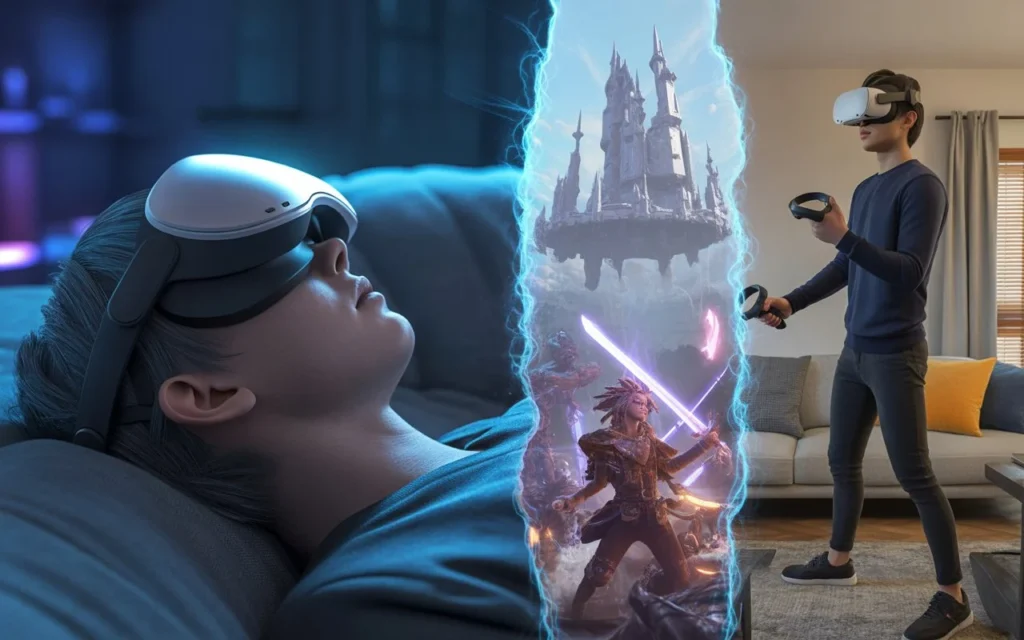
That’s the promise behind Sword Art Online VR—a version of virtual reality so immersive that it replaces your physical senses completely. But here’s the real question: how close are you to actually experiencing something like that?
In this in-depth guide, you’ll discover what Sword Art Online VR really is, how it works in fiction, how it compares to real virtual reality technology today, and whether full-dive VR could ever become part of your future.
When people search for Sword Art Online VR, they’re usually referring to the advanced virtual reality system featured in the anime and light novel series Sword Art Online, created by Reki Kawahara.
In the series, players use a device called the NerveGear—a helmet that connects directly to their brain. Instead of looking at a screen, your mind is fully immersed inside a digital world. This concept is known as FullDive virtual reality.
Here’s what makes SAO VR different from the VR you use today:
In simple terms, SAO VR replaces reality instead of overlaying it.
And that’s why it fascinates so many people.
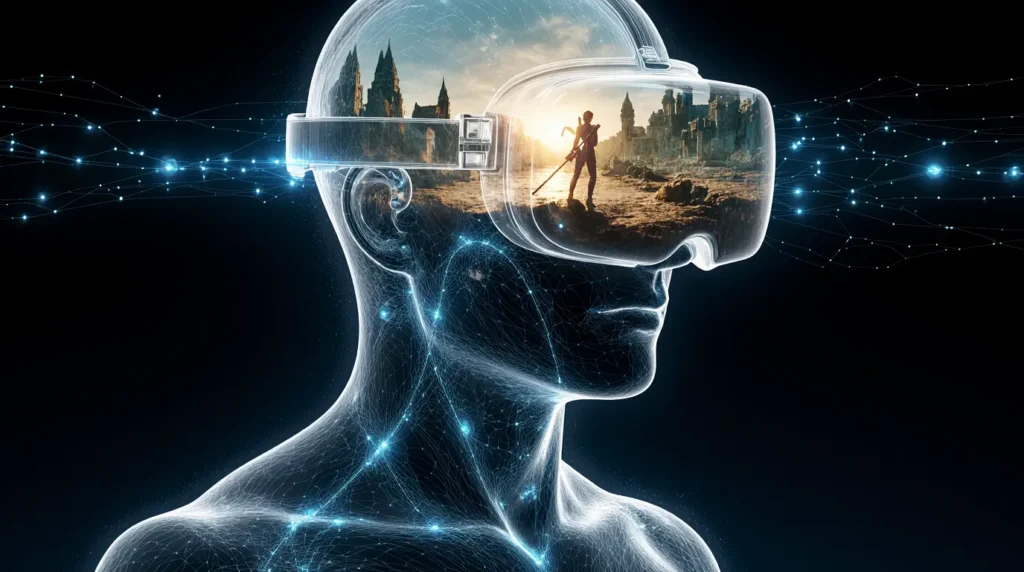
To understand how Sword Art Online VR compares to real virtual reality, you first need to understand how it works in fiction.
Inside the story, the NerveGear performs several groundbreaking functions.
Your brain constantly sends electrical signals to your body. When you move your hand, your brain fires a signal down your spinal cord.
In Sword Art Online VR, the NerveGear:
Instead of physically walking, your brain believes it’s walking inside the game.
The device doesn’t just block signals—it sends new ones.
It artificially generates:
You’re not “watching” the world. You’re experiencing it.
Unlike real VR systems that require handheld controllers, Sword Art Online VR lets you move as you normally would. If you want to swing a sword, you simply think about it. Your in-game avatar responds instantly.
That’s because your brain believes the digital body is your real one.
In the series, if the device is removed improperly, it can cause fatal consequences. While that dramatic element adds tension to the story, it also raises serious questions about safety and ethics in brain-computer interfaces.
Now, let’s step out of fiction and look at what you can actually buy today.
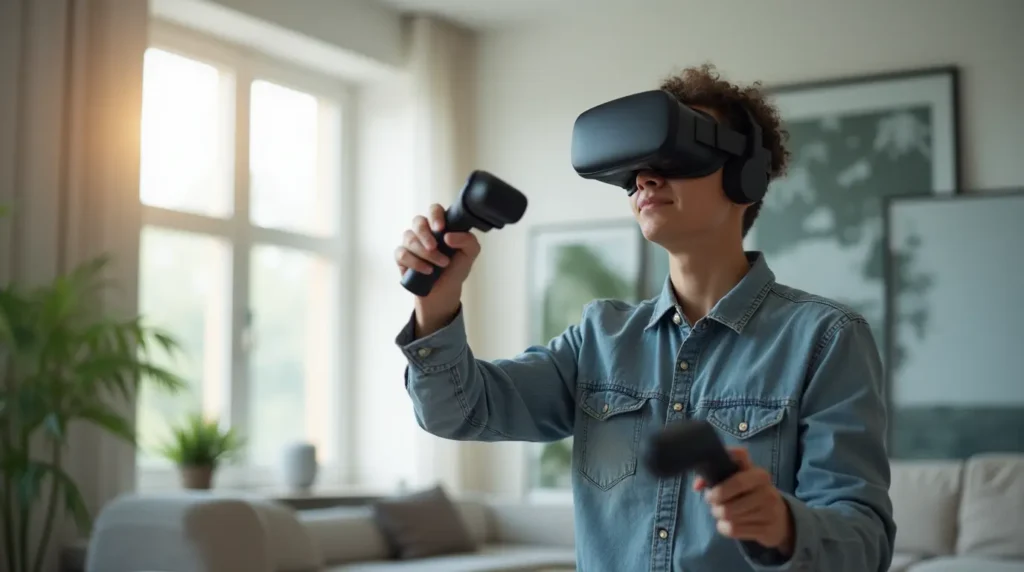
Real virtual reality is impressive—but it operates very differently from Sword Art Online VR.
Today’s VR technology relies on external hardware, not direct brain connections.
If you’ve tried modern VR systems like:
You already know the basics.
Here’s how real VR works:
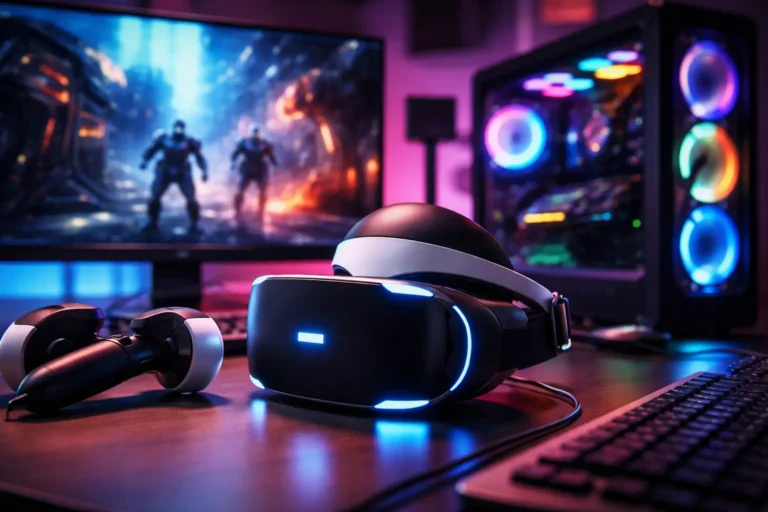
A headset places small screens in front of your eyes. These screens display slightly different images to create depth perception.
Cameras and sensors track:
Your movements are translated into the digital environment.
3D spatial audio enhances realism, making sounds feel directional and immersive.
Some devices include:
But these are still mechanical—not neural.
The biggest difference?
You remain fully conscious of your physical body. You’re wearing equipment. You’re standing in your living room. You can take the headset off anytime.
That’s a far cry from full-dive immersion.
Let’s compare them directly so you can see the contrast clearly.
Sword Art Online VR
Real VR
Sword Art Online VR
Real VR
Sword Art Online VR
Real VR
Sword Art Online VR
Real VR
Sword Art Online VR
Real VR
The gap between them is significant—but it’s not impossible to imagine bridges forming over time.
This is the question you’re probably most curious about.
Is sword art online vr just fantasy—or a preview of your future?
To answer that, you need to look at brain-computer interface (BCI) research.
A BCI is a technology that allows communication between your brain and an external device. Researchers are already experimenting with:
Some systems can already:
But here’s the limitation:
They are nowhere near capable of replicating full sensory immersion.
If sword art online vr were to become real, scientists would need to overcome:
Your brain contains roughly 86 billion neurons. Accurately reading and writing signals at that scale is an extraordinary challenge.
Even optimistic projections place full-dive VR decades away—if it’s possible at all.
If it’s not realistic yet, why does it continue to dominate discussions?
Because it taps into something deeper.
Life can feel limiting. Responsibilities, routines, and stress follow you daily.
Full-dive VR offers something radical:
That level of escape is powerful.
In SAO VR, your avatar reflects who you want to be. Stronger. Faster. More confident.
Virtual worlds allow you to experiment with aspects of yourself in ways real life sometimes doesn’t.
Massively multiplayer games have already shown you how strong digital communities can become.
Imagine that connection amplified through total immersion.
That’s why the concept resonates far beyond anime fans.
Even if Full Dive SAO VR isn’t arriving tomorrow, real VR is advancing quickly.
You’re already seeing:
Companies and researchers are also exploring:
Each improvement narrows the immersion gap—though neural integration remains the biggest hurdle.
The VR market continues to grow year after year, and adoption is expanding beyond gaming into:
While it’s not full-dive, it’s becoming more integrated into everyday life.
No. Sword Art Online VR, as depicted in the series, does not exist. Full-dive neural immersion technology remains theoretical.
You’re still far from experiencing full-dive VR. Brain-computer interfaces are advancing, but they cannot yet simulate entire sensory environments.
SAO VR connects directly to your brain and blocks physical movement. Modern VR headsets rely on screens, sensors, and physical interaction.
If full-dive VR were developed, it would require strict medical oversight, advanced safety protocols, and ethical regulation to ensure user protection.
Sword art online vr represents more than a fictional technology. It symbolizes a turning point—the moment where digital and physical existence merge completely.
Right now, you’re living in the early chapters of immersive technology. Real VR is powerful, but it still relies on hardware and physical awareness. Full-dive systems remain theoretical.
But here’s something worth considering:
Every transformative technology once sounded impossible.
If neural interfaces advance safely, and if immersive computing continues accelerating, the line between science fiction and reality may blur faster than you expect.
So what do you think?
Would you step into a world like SAO VR if it became real?
Share your thoughts, explore the future of virtual reality, and stay informed about emerging tech breakthroughs. The next evolution of immersion may arrive sooner than you imagine—and you’ll want to be ready when it does.