Physical Address
304 North Cardinal St.
Dorchester Center, MA 02124
Physical Address
304 North Cardinal St.
Dorchester Center, MA 02124


Discover augmented reality in accounting, improving efficiency, and shaping the future of finance.
You know the feeling. It’s late, your screen is packed with spreadsheets, and somewhere inside thousands of rows of data is the insight you need. You scroll, filter, and calculate. The numbers are there, but the clarity isn’t.
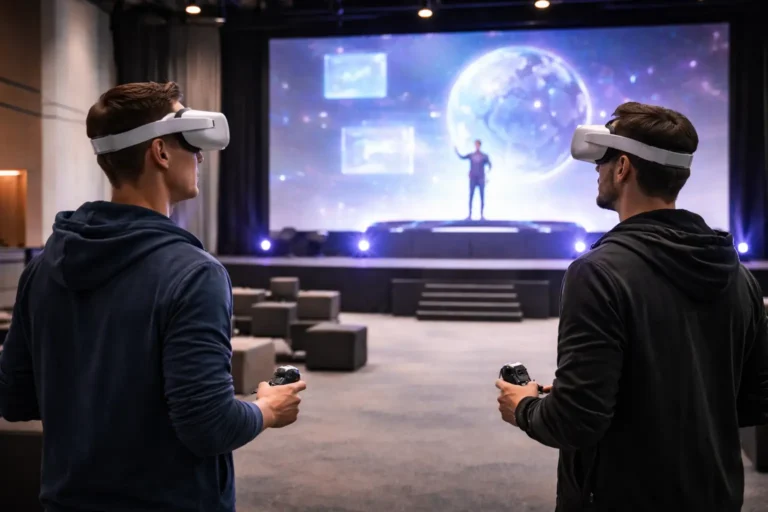
Now imagine lifting your tablet or wearing AR glasses and seeing your financial data projected as interactive 3D dashboards right in front of you. Revenue streams rise like columns. Risk indicators glow. Cash flow moves visually across departments.
That’s the promise of augmented reality in accounting. And while it may sound futuristic, it’s steadily moving into mainstream finance departments. If you want to stay competitive, this is a shift you can’t afford to ignore.
Accounting has already evolved dramatically:
Augmented reality (AR) is the next stage in digital finance transformation.
Instead of analyzing flat spreadsheets, you interact with dynamic financial layers in your physical space. AR overlays digital information onto your real-world environment through:
As your role becomes more strategic, tools like augmented reality accounting help you interpret and communicate insights faster and more effectively.
Augmented reality in accounting refers to the integration of AR technology with accounting systems to visualize, analyze, and manipulate financial data in an immersive, three-dimensional format.
Unlike virtual reality, which replaces your environment, AR enhances it.
With augmented reality in accounting, you can:
Core technologies include:
This combination turns static reports into interactive financial experiences.

Spreadsheets require interpretation. Visual models deliver clarity.
With augmented reality in accounting, you can:
When financial data becomes visual and interactive, insights surface faster.
In business, speed matters.
Augmented reality in accounting enables you to:
You move from reviewing data to actively engaging with it.
Modern finance teams are often remote or hybrid.
AR allows you to:
Instead of emailing reports, you collaborate in real time with shared visual data.
Auditing requires precision.
Augmented reality in accounting can:
Errors become visible instead of hidden in rows of data.
If you work in advisory or public accounting, communication is everything.
With AR-powered presentations, you can:
Clients don’t just hear the numbers, they see them.

Quarterly and annual reports can become interactive experiences.
You can:
Board meetings shift from explanation to strategy.
AR tools may assist auditors by:
The review process becomes faster and more transparent.
Budget discussions are often complex.
With augmented reality accounting, you can:
Forecasting becomes interactive rather than static.
New accountants often face steep learning curves.
AR training systems can:
Training becomes experiential rather than theoretical.
AI strengthens AR by:
When AI projections are visualized through AR, your analytical power increases significantly.
Cloud infrastructure supports:
This makes augmented reality in accounting more accessible to businesses of all sizes.
Lightweight smart glasses may soon become practical tools for:
As hardware improves, adoption barriers continue to decrease.
Security remains a top priority.
Future AR accounting platforms may incorporate:
Trust and innovation must evolve together.
Despite its promise, augmented reality accounting comes with considerations:
Digital transformation succeeds only when change management is handled effectively.
Evaluate:
Strong foundations make AR implementation smoother.
Instead of large-scale deployment:
Measure ROI before expanding.
Your team should develop:
Technology only adds value when people use it effectively.

Accounting is shifting from transactional processing to strategic advisory.
Augmented reality accounting may soon:
As innovation accelerates, firms that embrace immersive financial tools will stand out in efficiency, clarity, and client experience.
Augmented reality accounting is the use of AR technology to visualize and interact with financial data in real time through immersive, 3D digital overlays.
It enhances reporting by transforming static financial data into interactive visual models, making insights easier to understand and communicate.
Initial investment may be significant, but scalable cloud-based solutions and pilot programs can reduce financial risk while testing ROI.
Yes. As AR technology becomes more accessible, smaller businesses can adopt cloud-based augmented reality accounting tools tailored to their needs.
With proper encryption, compliance alignment, and secure infrastructure, augmented reality accounting can meet high security standards similar to other enterprise financial systems.
You’ve adapted to cloud platforms. You’ve embraced automation. You’ve seen AI reshape forecasting.
Augmented reality in accounting is simply the next layer.
It won’t replace your expertise, it will enhance it. It won’t eliminate analysis, it will sharpen it. And it won’t transform accounting overnight, but it will steadily redefine how you see, interpret, and communicate financial data.
If you want to stay ahead, now is the time to explore it.
Start small. Stay informed. Experiment strategically.
Because the future of accounting isn’t just about numbers.
It’s about seeing them differently.