Physical Address
304 North Cardinal St.
Dorchester Center, MA 02124
Physical Address
304 North Cardinal St.
Dorchester Center, MA 02124


Discover how augmented reality reading is transforming books into interactive experiences. Learn how AR enhances learning, engagement, and education.
Think about the last time you truly lost yourself in a book. You pictured the setting in your mind. You imagined the characters’ voices. You tried to understand complex ideas using only text and static images.
Now imagine pointing your phone at a page and watching a 3D solar system spin above it. Or seeing a historical battle unfold across your desk. Or hearing a character speak as you read their dialogue.
That’s the promise of augmented reality reading.

You’re not replacing books. You’re enhancing them. And whether you’re a parent, teacher, student, or publisher, this shift affects how you read, how you teach, and how you learn.
In this guide, you’ll discover what augmented reality reading really is, how it works, why it matters, and how you can start using it today.
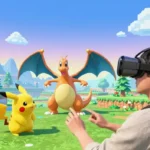
Augmented reality reading combines traditional reading materials with interactive digital overlays. When you scan a page using a smartphone or tablet, digital elements, such as 3D models, animations, sound effects, or quizzes, appear on top of the physical book.
Unlike virtual reality, which replaces your environment, augmented reality (AR) enhances what’s already in front of you.
When applied to books, AR transforms passive reading into interactive exploration.
At its core, augmented reality reading relies on four main components:
Here’s what happens step by step:
Instead of simply reading about the human heart, you rotate it in 3D. Instead of imagining a volcano, you watch it erupt safely in your living room.
That’s augmented reality reading in action.
You’re living in a world where attention is constantly pulled toward screens. Traditional reading competes with short-form videos, interactive games, and social media feeds.
Augmented reality reading bridges that gap.
It blends the tactile experience of physical books with the interactivity that today’s readers expect.
Several trends are driving its growth:
If you’ve noticed children losing interest in traditional textbooks, AR offers a compelling solution.
When you engage multiple senses, your brain processes information more effectively. Instead of only reading words, you see movement, hear narration, and interact with visual elements.
This multi-sensory input helps you:
For example, if you’re learning anatomy, a 3D rotating organ gives you spatial clarity that flat diagrams simply cannot provide.
You don’t just read the concept, you experience it.
If you’ve ever struggled to encourage a child to read, you know motivation matters.
Augmented reality reading introduces:
Instead of viewing reading as a task, children begin to see it as exploration.
When characters move, and scenes animate, curiosity replaces resistance.
Not everyone learns the same way. Some people absorb information visually. Others prefer audio cues. Some need interaction.
Augmented reality reading supports:
If you teach or homeschool, this flexibility can dramatically improve how your students respond to lessons.
AR reading tools often include features such as:
If you’re working with students who face reading challenges, augmented reality reading can reduce barriers and increase confidence.

Classrooms are evolving. Chalkboards have become smart boards. Paper assignments are submitted online. Reading itself is becoming interactive.
You’ll find augmented reality reading integrated into:
Imagine teaching planetary motion and allowing students to manipulate orbit paths in real time. Or exploring ancient architecture through 3D reconstructions layered over textbook images.
The difference in engagement is noticeable.
If you’re an educator, AR reading can help you:
Instead of spending extra time drawing diagrams on a board, you let the book come alive.
You don’t need to transform your entire curriculum overnight. Small experiments can show meaningful results.
As a parent, you may worry about screen time. That concern is valid.
But augmented reality reading reframes the screen as a learning tool instead of pure entertainment.
You can:
Instead of replacing bedtime stories, you enhance them.
You remain involved. The technology simply adds depth.
If you’re in publishing, augmented reality reading isn’t just a trend, it’s a competitive edge.
AR-enhanced books can open opportunities such as:
You’re no longer selling just a book. You’re offering an evolving digital experience.
Book markets are saturated. Thousands of titles launch every day.
An AR-enhanced book:
In a digital-first generation, innovation captures attention.
While the benefits are compelling, you should understand the challenges.
Not every household has the latest device. Accessibility can vary.
Creating AR content requires:
For publishers and schools with limited budgets, these costs may slow adoption.
Teachers and parents must learn how to integrate AR tools effectively.
Technology alone doesn’t guarantee better learning outcomes. Implementation matters.
If you plan to adopt augmented reality reading, preparation is essential.
Technology rarely moves backward. It evolves.
Augmented reality reading is likely to expand alongside advances in artificial intelligence and wearable devices.
Soon, AR reading experiences may:
Instead of static content, your book adjusts to your learning pace.
Smart glasses could eliminate the need to hold a phone over a page.
Imagine reading naturally while subtle holographic elements appear seamlessly in your field of vision.
The experience becomes hands-free and immersive.
You don’t need specialized hardware to begin.
Here’s a practical roadmap:
Start small. Evaluate results. Expand gradually.
Augmented reality reading enhances physical or digital books by overlaying interactive digital content—such as 3D animations, audio narration, or quizzes—onto the page through a smartphone or tablet.
Yes. Augmented reality reading increases engagement and motivation by transforming static text into interactive experiences, which can improve comprehension and retention.
In most cases, you only need a smartphone or tablet with an AR-compatible app. Advanced experiences may use smart glasses, but they are not required.
It improves outcomes by:
No. Augmented reality reading complements traditional books. It enhances the experience without removing the foundational value of reading.
Reading has always been powerful. It builds imagination, knowledge, and critical thinking.
Augmented reality reading doesn’t diminish that power—it amplifies it.
If you’re a parent, you can reignite curiosity.
If you’re a teacher, you can elevate engagement.
If you’re a publisher, you can innovate your offerings.
If you’re a learner, you can experience content in entirely new ways.
The question isn’t whether augmented reality reading will grow.
The real question is whether you’ll adopt it early or watch from the sidelines.
Start exploring AR-enhanced books today. Test one interactive lesson. Download one app. Experiment with one story.
You don’t have to change everything at once.
But you can take the first step now.