Physical Address
304 North Cardinal St.
Dorchester Center, MA 02124
Physical Address
304 North Cardinal St.
Dorchester Center, MA 02124

What are AR glasses? Learn how augmented reality glasses work, the technology behind them, real-world uses, and why AR glasses are becoming important in 2026.
You already depend on screens. You check directions on your phone, scan notifications on your smartwatch, and join meetings through a laptop camera. Now imagine lifting your eyes and seeing relevant digital information layered directly into your surroundings, without pulling a device from your pocket.
That shift is why so many people are asking: What are AR glasses, and are they about to change how you interact with technology?
In this in-depth guide, you’ll discover how augmented reality glasses work, what technology powers them, how they differ from VR headsets, and why 2026 is shaping up to be a pivotal year for wearable AR.
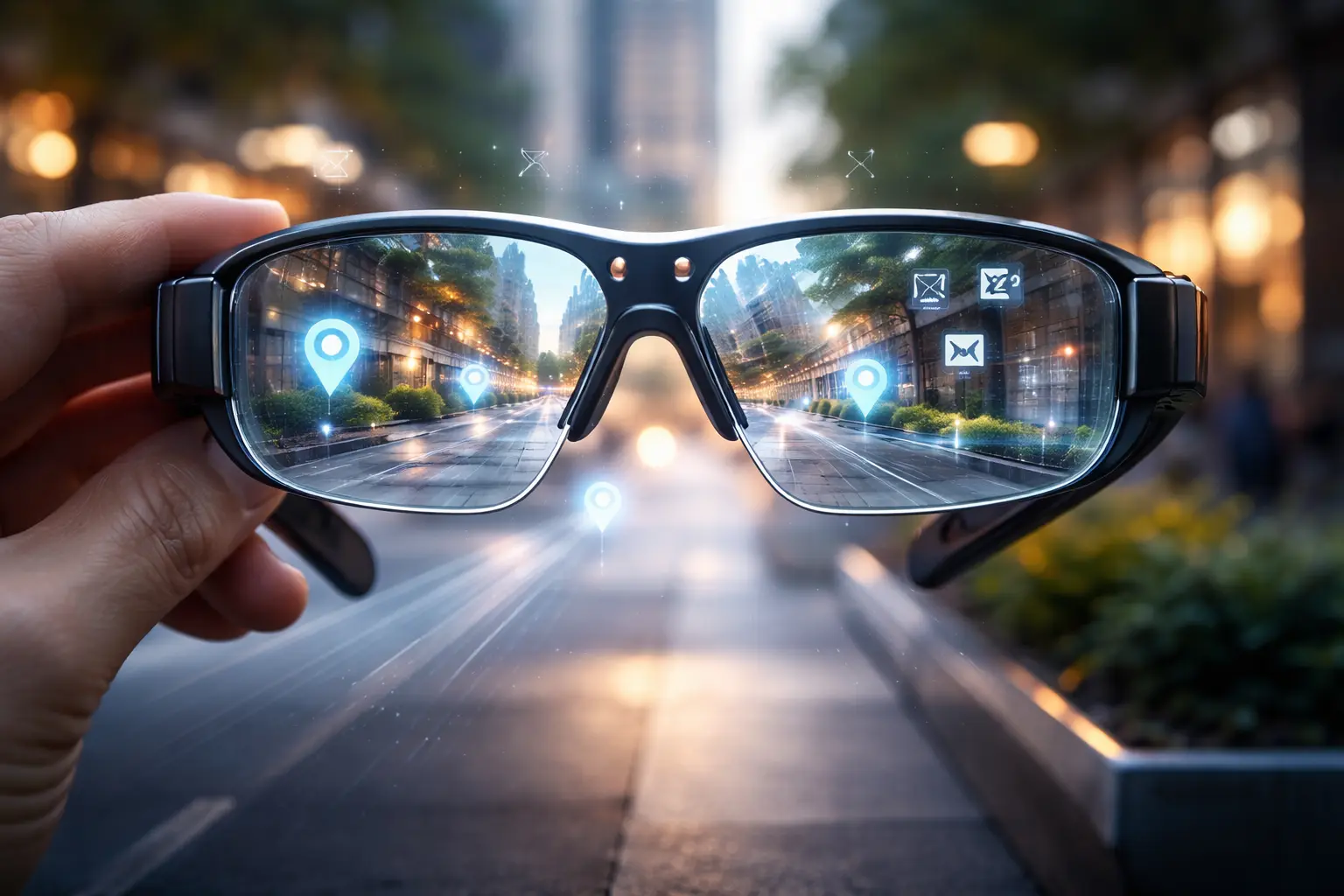
AR glasses are wearable devices that overlay digital content onto your real-world view. Instead of replacing your surroundings with a fully virtual environment, they enhance what you see with contextual information, graphics, or 3D objects.
When you wear augmented reality glasses, you still see your physical environment. The difference is that digital elements, directions, notifications, 3D models, and live data appear anchored in your field of view.
Understanding what AR glasses are requires distinguishing them from similar technologies:
For example, a VR headset like Meta Quest 3 replaces your view entirely. AR glasses, by contrast, keep you connected to your surroundings while adding digital layers.
To understand what AR glasses truly are, you need to look inside them. The technology combines advanced optics, sensors, processing units, and software that work together in real time.
The display system is what allows digital images to appear in your field of vision without blocking the real world.
Common display approaches include:
Waveguides, for instance, channel light from a small projector embedded in the frame into your eyes through transparent glass. This makes the digital image appear as though it exists in the space in front of you.
AR glasses must understand where you are and what you are looking at. To achieve this, they use:
SLAM allows the glasses to map your environment and anchor digital objects in fixed positions. If you place a virtual screen on your wall, it stays there as you move.
Not all AR glasses process data the same way. There are three main approaches:
For example, enterprise-focused systems like Microsoft HoloLens 2 include onboard computing. Consumer-oriented models may rely on smartphones to reduce weight.
The AR glasses market has evolved into distinct categories.
These are designed for everyday use and typically focus on:
Some consumer-focused smart glasses, such as Ray-Ban Meta Smart Glasses, blend fashion with lightweight augmented capabilities.
Enterprise systems prioritize productivity and industrial use cases:
These devices tend to be more powerful and more expensive.
When evaluating augmented reality glasses, consider:
Standalone devices offer freedom but often weigh more. Tethered systems are lighter but depend on another device.
Major technology companies are investing heavily in spatial computing.
Meta continues expanding into mixed and augmented reality, integrating AI and social features into wearable devices.
Apple has emphasized spatial computing and ecosystem integration, signaling long-term investment in wearable AR technologies.
These companies are positioning AR glasses as companions to smartphones rather than immediate replacements.
Microsoft has focused on enterprise applications, particularly in defense, manufacturing, and remote collaboration environments.
Enterprise adoption often drives early innovation because companies are willing to invest in productivity gains.
If you are comparing devices, you need clarity on functionality.
| Use Case | AR Glasses | VR Headsets |
|---|---|---|
| Navigation | Excellent | Not practical |
| Industrial training | Strong | Strong |
| Gaming | Limited immersion | High immersion |
| Remote collaboration | Strong | Moderate |
If your goal is everyday productivity, AR glasses offer more flexibility.
Understanding what are AR glasses becomes easier when you see how they are used.
Imagine walking through a city and seeing arrows appear directly on the street in front of you. No need to look down at a phone.
Surgeons can view patient data while keeping their eyes on the procedure. AR overlays reduce the need to look away from critical tasks.
Field technicians can:
This reduces downtime and improves accuracy.
AR glasses may allow you to:
Students can explore:
AR makes abstract concepts tangible.
Despite progress, AR glasses face obstacles.
Small form factors limit battery capacity. Many devices last only a few hours under continuous use.
Current AR glasses often display digital content in a limited window rather than across your entire field of vision.
Always-on cameras raise legitimate questions about consent and data protection.
Enterprise models can cost thousands of dollars. Consumer pricing remains a barrier to mass adoption.
The importance of AR glasses goes beyond hardware. They represent a shift in how you interact with digital information.
Instead of tapping screens, you interact with digital objects placed in physical space. This changes interface design fundamentally.
AR glasses increasingly integrate artificial intelligence:
AI enhances the usefulness of wearable AR by reducing friction.
Will AR glasses replace smartphones? Not immediately.
However, they may reduce how often you need to look at your phone. Notifications, navigation, and lightweight tasks can move into your field of view.
If you are considering purchasing augmented reality glasses, evaluate your priorities.
Matching your needs to the right category prevents overpaying for unnecessary features.
AR glasses are wearable devices that overlay digital information onto your real-world view using optical displays, cameras, sensors, and spatial mapping software.
They are used for navigation, enterprise productivity, training, collaboration, retail experiences, and contextual information delivery.
Yes, both consumer and enterprise models are available, though capabilities vary significantly between products.
AR glasses enhance your physical surroundings with digital overlays, while VR headsets replace your view with a fully virtual environment.
They are more likely to complement smartphones in the near term rather than replace them entirely.
You are witnessing a transition from handheld computing to spatial computing. AR glasses move digital interaction into your environment, allowing you to stay present while accessing information.
While technical limitations remain, battery life, field of view, and cost, the direction is clear. Major technology companies are investing heavily, enterprise adoption continues to grow, and AI integration is accelerating progress.
If you want to stay ahead of emerging technology trends, now is the time to understand how AR glasses fit into your workflow, your business strategy, and your everyday life.