Physical Address
304 North Cardinal St.
Dorchester Center, MA 02124
Physical Address
304 North Cardinal St.
Dorchester Center, MA 02124


Explore the leading AR VR companies, their projects, and innovations in augmented and virtual reality
Augmented reality and virtual reality used to sound like something pulled from science fiction. Today, they are becoming tools you can use in your daily life. When you put on a VR headset, you step into a fully digital world. When you look through an AR interface, digital information blends with the environment around you.
Behind these experiences are powerful AR and VR companies investing billions of dollars in research, hardware development, and software ecosystems. These organizations are building the technology that allows you to explore virtual worlds, train in realistic simulations, or visualize complex data in three dimensions.
Understanding which companies lead the industry can help you see where immersive technology is heading and which platforms might shape your future digital experiences.
According to market research from International Data Corporation (IDC) and Statista, global spending on AR and VR technologies has grown rapidly in recent years as businesses adopt immersive tools for training, collaboration, and product design.
AR and VR companies develop the hardware, software, and platforms that enable immersive digital experiences.
To understand their importance, it helps to know the difference between the two core technologies.
Augmented Reality (AR) overlays digital content onto the physical world. You still see your real surroundings, but additional information appears on top of them.
Virtual Reality (VR) places you inside a fully simulated environment using a headset and motion tracking technology.
When these technologies combine, they create what many researchers call extended reality (XR).
Organizations such as PwC have reported that immersive technologies could contribute trillions of dollars to the global economy by the end of the decade through improved productivity, remote collaboration, and advanced training systems.
You may encounter AR and VR in many areas of life:
Because these applications continue to expand, AR and VR companies are becoming central players in the global technology industry.
The top AR and VR companies are not just creating headsets. They are building entire ecosystems that include hardware, operating systems, development tools, and cloud platforms.
Immersive devices have improved dramatically in recent years.
Modern headsets include:
These improvements make virtual environments feel more realistic and comfortable to use.
Hardware alone cannot create immersive experiences. Developers need powerful software frameworks to build applications.
Many AR and VR companies provide:
These ecosystems allow developers to create games, training tools, and productivity applications.
You may associate VR with gaming, but many industries now depend on immersive technology.
Key sectors using AR and VR include:
Companies leading this transformation are shaping how organizations train employees, design products, and interact with digital information.

Several technology companies dominate the AR and VR landscape in 2026. Some focus on consumer devices, while others build enterprise solutions.
One of the most influential AR and VR companies in the world is Meta.
Meta has invested heavily in virtual reality and immersive platforms. Its VR ecosystem focuses on making immersive technology accessible to consumers.
Key contributions include:
Meta’s long-term strategy centers on building immersive digital spaces where users can work, socialize, and explore virtual environments.
Apple entered the spatial computing space with a strong focus on integrating AR into its existing ecosystem.
The company provides developers with tools such as ARKit, allowing them to build augmented reality experiences directly for Apple devices.
Key innovations include:
Apple’s strategy focuses on combining hardware, software, and services into a unified ecosystem, which has historically been one of the company’s strongest advantages.
Sony plays a major role in VR gaming.
Its PlayStation VR platform connects immersive technology directly to the company’s gaming ecosystem.
Key features include:
Gaming remains one of the largest drivers of VR adoption, which makes Sony an important player among AR and VR companies.
– Explore more about VR in Gaming.
Not all immersive technology targets consumers. Many AR and VR companies focus on enterprise applications where organizations use immersive tools for training and productivity.
Microsoft has focused heavily on mixed reality for business and industrial use.
The company’s immersive solutions support industries such as healthcare, engineering, and manufacturing.
Key capabilities include:
By combining spatial computing with its cloud infrastructure, Microsoft enables organizations to create collaborative digital environments.
HTC’s Vive platform has become widely used in both gaming and enterprise environments.
The company produces VR hardware designed for professional training and simulation.
Industries using HTC technology include:
Because of its focus on high-performance VR devices, HTC continues to be a strong competitor in the immersive technology market.
Magic Leap focuses on augmented reality solutions designed primarily for enterprise users.
Its AR devices allow digital objects to appear naturally within the physical world.
Common enterprise applications include:
AR solutions like these allow professionals to see critical data while continuing to interact with real-world environments.
In addition to major technology corporations, several innovative companies are pushing immersive technology forward.
Niantic is known for location-based augmented reality experiences.
Its technology allows digital objects to interact with real-world locations using smartphone cameras and mapping systems.
This approach has demonstrated how AR can transform outdoor environments into interactive spaces.
Varjo develops ultra-high-resolution VR headsets used in professional simulation environments.
Industries using Varjo technology include:
These professional-grade devices deliver extremely detailed visual environments.
Snap AR has become an important AR innovator through its camera platform.
The company provides tools that allow creators and developers to design interactive augmented reality experiences.
Millions of users interact with AR content through Snap’s mobile platform each day.
The rapid growth of AR and VR companies depends on several major technological advances.
Spatial computing allows computers to understand physical environments and place digital objects within them.
This technology enables AR devices to anchor virtual objects to real-world locations.
Computer vision allows devices to interpret visual information from cameras.
This enables AR applications to detect surfaces, recognize objects, and track movement.
AI enhances immersive experiences by improving:
Fast wireless networks allow immersive applications to stream high-quality content from cloud servers.
This reduces the need for heavy hardware while enabling more complex digital environments.
If you are exploring immersive technology, understanding how to evaluate AR and VR companies can help you make informed decisions.
Several factors matter when comparing companies.
Look for companies developing:
Better hardware typically results in more immersive experiences.
The success of an AR or VR platform often depends on the developer community supporting it.
Platforms with strong developer tools tend to produce more applications and content.
Many AR and VR companies generate revenue through enterprise solutions.
Industries adopting immersive technology include healthcare, manufacturing, and training.
Companies that invest heavily in R&D are more likely to develop breakthrough technologies that shape the future of immersive computing.
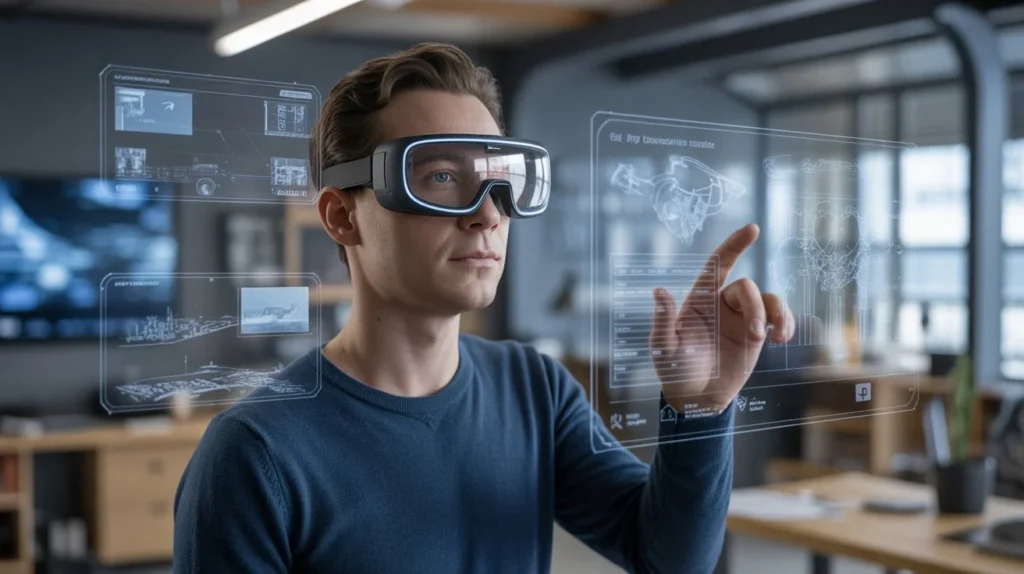
The immersive technology industry is still evolving.
Several trends may shape the next stage of development.
Future AR devices may look more like ordinary glasses than bulky headsets.
These devices could display navigation information, notifications, and digital content directly in your field of view.
Artificial intelligence will likely improve how immersive systems understand and interact with real environments.
This could make AR interfaces far more intuitive.
Researchers often describe immersive technology as the foundation for a spatial internet, where digital content exists in three-dimensional environments rather than traditional screens.
AR and VR companies develop technologies that enable augmented reality and virtual reality experiences. These technologies include immersive headsets, AR glasses, spatial computing software, and development platforms.
Several companies lead the immersive technology industry, including:
These organizations invest heavily in hardware, software ecosystems, and immersive platform development.
Many industries now use immersive technology, including:
AR and VR technologies are rapidly transforming how you interact with digital information. The most influential AR and VR companies are building the hardware, software platforms, and immersive ecosystems that will shape the next generation of computing.
From consumer devices to enterprise simulation systems, immersive technology is expanding into nearly every industry. As these platforms evolve, they will likely become an essential part of how people work, communicate, and explore digital environments.
If you want to stay ahead of the next wave of innovation, keep watching the progress of these AR and VR companies. Their breakthroughs will define the future of immersive technology.
If this guide helped you understand the industry, consider exploring more articles on immersive technology, VR devices, and spatial computing to stay informed about the technologies that may soon reshape your digital world.