Physical Address
304 North Cardinal St.
Dorchester Center, MA 02124
Physical Address
304 North Cardinal St.
Dorchester Center, MA 02124


Discover how augmented reality in education enhances student engagement, improves knowledge retention, and transforms learning through interactive 3D experiences, simulations, and immersive technologies.
Education has changed dramatically over the last decade. Traditional textbooks, static diagrams, and one-way lectures are no longer the only tools available to teachers and students. Today, technology is reshaping classrooms, making learning more interactive, engaging, and effective than ever before. One of the most exciting innovations driving this transformation is augmented reality in education.
Imagine studying the human heart by viewing a realistic 3D model floating above your desk. Picture learning about ancient civilizations by exploring historical landmarks through your smartphone. Instead of simply reading about scientific concepts, you can interact with them in real time. This is the power of augmented reality (AR).

As schools, universities, and online learning platforms continue to embrace digital transformation, augmented reality is becoming an essential educational tool. It helps students understand complex concepts, increases engagement, and creates memorable learning experiences.
In this article, you’ll discover how augmented reality in education works, its benefits, real-world applications, challenges, future trends, and the best ways to implement it in learning environments.
Augmented reality in education refers to the use of AR technology to enhance learning experiences by overlaying digital content onto the physical world.
Unlike virtual reality, which creates a completely digital environment, AR adds virtual elements to your real surroundings. Students can still see and interact with the physical world while accessing additional digital information.
Examples include:
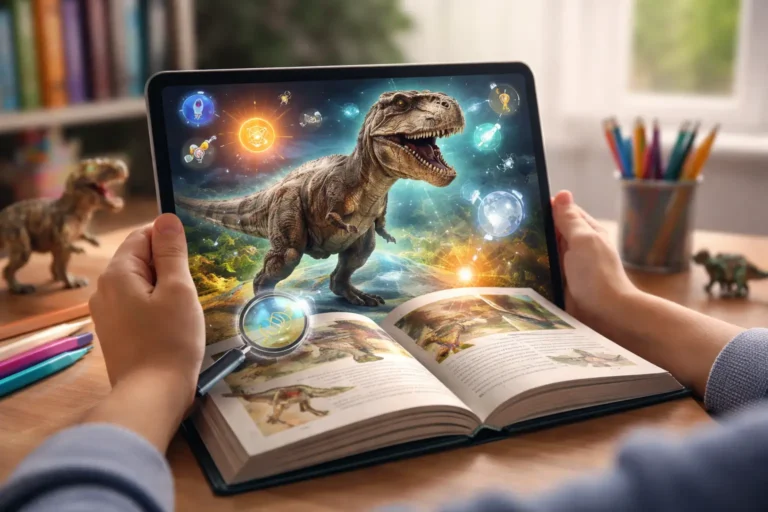
For example, a biology student can point a tablet at a textbook image and instantly see a three-dimensional representation of the human body. This creates a richer learning experience compared to viewing a flat image on a page.
Several technologies work together to create augmented reality experiences:
These components allow AR systems to recognize objects, track movements, and display relevant digital content.
Understanding how AR functions can help you appreciate its educational value.
The process usually follows these steps:
For example, when studying astronomy, students can scan a page in a textbook and see a rotating model of the solar system appear on their device.
Educational AR experiences can be accessed through:
Since many students already have access to smartphones and tablets, AR implementation is becoming increasingly affordable for educational institutions.
The growing popularity of educational AR is largely due to the numerous benefits it offers.

One of the biggest challenges educators face is maintaining student attention. Traditional teaching methods can sometimes feel repetitive, especially for digital-native learners.
AR introduces:
When students actively participate in lessons, they become more invested in the learning process.
People tend to remember information better when they experience it rather than simply read or hear about it.
Augmented reality supports:
By combining visual and interactive elements, AR helps students retain information for longer periods.
Some subjects contain abstract ideas that are difficult to explain using traditional methods.
Examples include:
AR makes these concepts visible and interactive, helping students develop a deeper understanding.
Every student learns differently. Some learn through reading, while others learn through observation or interaction.
Augmented reality allows students to:
This flexibility supports diverse learning styles and abilities.
AR activities often encourage teamwork and discussion.
Students can:
As a result, communication and teamwork skills improve alongside academic performance.
AR technology is being used across all levels of education.
Primary and secondary schools are increasingly adopting AR to make lessons more engaging.
Common applications include:
Students can explore volcanoes, ecosystems, planets, and historical sites without leaving the classroom.
Universities use AR to provide advanced learning experiences.
Popular use cases include:
Medical students can:
Engineering students can:
AR helps architecture students:
Remote education often lacks the hands-on experiences available in traditional classrooms.
Augmented reality helps bridge this gap through:
Students can conduct virtual experiments and explore concepts from home.
AR also supports students with unique learning needs.
Benefits include:
These features can make education more inclusive and accessible.
Many institutions are already using AR successfully.
Medical schools around the world use AR applications to teach anatomy and clinical procedures.
Students can:
This provides valuable experience before working with real patients.
AR applications allow students to:
These interactive experiences improve comprehension and curiosity.
Instead of simply reading about historical events, students can:
This creates stronger emotional and educational connections to the material.
Science, Technology, Engineering, and Mathematics programs benefit significantly from AR.
Students can interact with:
The ability to visualize abstract concepts makes learning more effective.
Despite its advantages, AR implementation comes with challenges.
Educational institutions may face issues such as:
Schools need reliable infrastructure to support AR initiatives.
Although AR technology is becoming more affordable, costs remain a concern.
Expenses may include:
Budget limitations can slow adoption in some regions.
Technology alone does not guarantee success.
Educators must understand:
Professional development is critical for successful implementation.
Not all AR educational content is equally valuable.
Schools should carefully evaluate:
High-quality content delivers better learning outcomes.
Several AR platforms are helping educators create engaging learning experiences.
Merge EDU allows students to interact with virtual objects using a handheld device.
Features include:
JigSpace helps explain complex topics through interactive 3D presentations.
Benefits include:
This application is particularly useful for medical and biology students.
It offers:
Quiver combines coloring activities with augmented reality experiences.
Ideal for younger students, it transforms drawings into animated 3D content.
CoSpaces Edu enables teachers and students to create their own AR experiences.
Users can:
The future of AR in education looks promising.
AI-powered AR systems will provide:
This combination will create highly customized educational experiences.
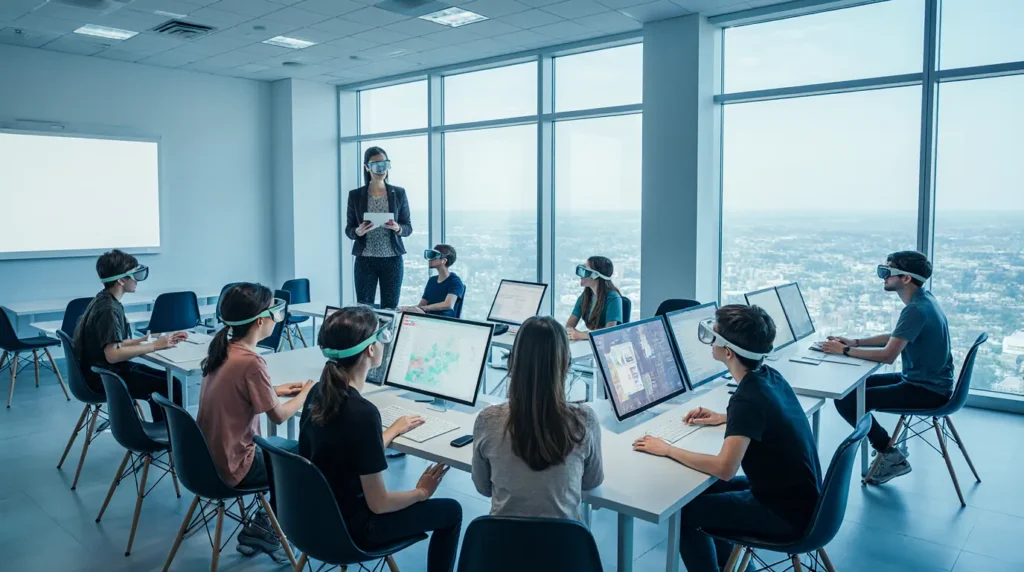
Future classrooms may feature:
Students will interact with information in entirely new ways.
Emerging virtual environments may combine AR and immersive technologies.
Potential benefits include:
As technology advances, AR solutions are expected to become:
This will encourage broader adoption across educational institutions worldwide.
Implementing AR requires careful planning.
Schools should identify:
Technology should support educational outcomes rather than replace them.
Consider:
Selecting appropriate tools increases the likelihood of success.
Teachers need ongoing training to:
Well-prepared educators maximize the value of AR investments.
Small-scale pilot projects allow schools to:
This reduces implementation risks.
Track metrics such as:
Data-driven decisions improve long-term success.
Augmented reality in education is the use of AR technology to overlay digital content onto the real world, creating interactive learning experiences that enhance student understanding and engagement.
AR improves education by making learning more interactive, increasing student participation, enhancing knowledge retention, and helping learners understand complex concepts through visualization.
Key benefits include:
Costs vary depending on the devices and software used. However, many schools can begin with affordable smartphones and tablets, making AR more accessible than ever before.
AR is particularly effective in:
Popular options include:
The future includes AI-powered learning experiences, smart classrooms, immersive educational environments, and broader adoption across schools and universities worldwide.
Augmented reality in education is no longer a futuristic concept; it is becoming an essential part of modern learning. By combining digital content with real-world environments, AR creates engaging, interactive experiences that help students understand complex concepts, retain information, and stay motivated throughout their educational journey.
Whether you are a teacher looking to enhance classroom engagement, an administrator exploring innovative learning tools, or a student seeking a more immersive educational experience, augmented reality offers exciting opportunities. As technology becomes more accessible and affordable, its impact on education will continue to grow.
Now is the perfect time to explore how augmented reality can transform your learning environment. Start with a small pilot project, experiment with educational AR applications, and discover how interactive technology can unlock new possibilities for teaching and learning. The future of education is already here, and it is more interactive than ever.