Physical Address
304 North Cardinal St.
Dorchester Center, MA 02124
Physical Address
304 North Cardinal St.
Dorchester Center, MA 02124

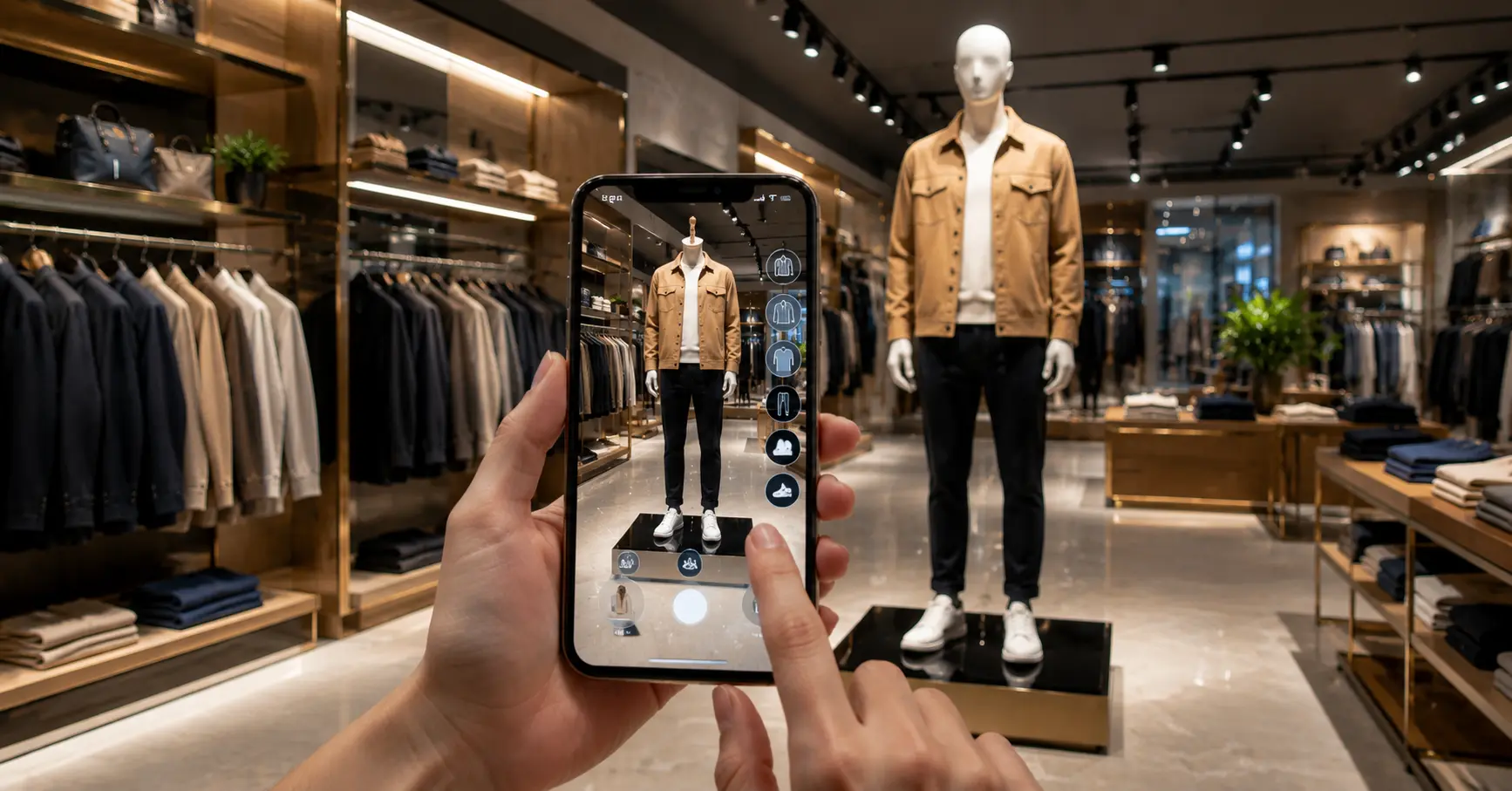
Discover how augmented reality in retail is transforming shopping experiences. Explore key benefits, real-world examples, use cases and market trends.
Shopping has changed dramatically over the past decade. Consumers no longer rely solely on physical stores to evaluate products before making a purchase. They browse online, compare options across multiple platforms, read reviews, and expect a seamless experience whether they shop from home or visit a store. In this evolving landscape, augmented reality in retail has emerged as one of the most powerful technologies helping brands bridge the gap between digital and physical shopping experiences.
Augmented reality (AR) allows retailers to overlay digital elements onto the real world through smartphones, tablets, smart mirrors, and wearable devices. Whether you are trying on a pair of glasses virtually, placing a sofa in your living room before purchasing it, or viewing product details through an interactive display, AR makes shopping more engaging and informative.
As consumer expectations continue to rise, businesses across industries are investing heavily in AR solutions. The growing augmented reality in retail market reflects this trend, with retailers recognizing the technology’s ability to increase customer satisfaction, improve conversion rates, and reduce product returns.
In this article, you’ll discover how augmented reality is transforming retail, the benefits it offers, practical use cases, successful examples, and the future trends shaping the next generation of shopping experiences.
Augmented reality in retail refers to the use of AR technology to enhance the shopping experience by combining digital content with the real-world environment.
Using a smartphone camera or other AR-enabled device, customers can interact with products in new ways before making a purchase decision.
For example, you can:
The primary goal is to remove uncertainty from the buying process and help customers make informed purchasing decisions.
Modern consumers want convenience, personalization, and confidence when shopping. Traditional product photos and descriptions often fail to provide enough information for customers to feel comfortable making a purchase.
AR solves this problem by allowing shoppers to interact with products virtually before buying them. As a result, retailers gain several competitive advantages, including higher engagement, improved customer trust, and increased sales.
The rapid adoption of smartphones and advancements in computer vision, artificial intelligence, and 3D modeling have also made AR more accessible and cost-effective than ever before.
The augmented reality in retail market has experienced remarkable growth in recent years. Businesses are increasingly recognizing the technology’s value in improving customer experiences and driving revenue.
Several factors are fueling this expansion:
Retailers are no longer viewing AR as a futuristic concept. Instead, it has become a practical business tool capable of delivering measurable results.
Industries such as fashion, beauty, furniture, electronics, and home décor are among the leading adopters, but AR is rapidly expanding into other retail sectors as well.
As technology continues to improve and implementation costs decrease, experts expect AR adoption to accelerate across both large enterprises and smaller retailers.
The success of AR in retail can largely be attributed to the tangible benefits it delivers to both customers and businesses.
When customers feel confident about a purchase, they are more likely to complete the transaction.
AR helps eliminate doubts by providing realistic previews and virtual experiences that simulate product ownership before purchase.
As a result, retailers often see increased conversion rates and higher average order values.
Returns are a major challenge for online retailers.
Many returns occur because customers receive products that differ from their expectations.
AR reduces this issue by allowing shoppers to visualize products accurately before buying, helping them make more informed decisions.
Interactive experiences naturally capture attention more effectively than traditional product pages.
AR encourages customers to spend more time exploring products, which can lead to stronger brand connections and increased purchase intent.
Customers remember unique experiences.
Brands that offer innovative AR features often stand out from competitors and create stronger emotional connections with shoppers.
Over time, this can translate into higher customer retention and repeat purchases.
AR applications extend far beyond simple product visualization. Today, retailers are using the technology across multiple touchpoints in the customer journey.
Virtual try-on technology has become one of the most popular AR applications.
Customers can see how products look on them before making a purchase.
Common examples include:
This functionality helps reduce uncertainty while improving confidence and satisfaction.
Many products are difficult to evaluate online because size, color, and placement matter.
AR allows customers to place virtual versions of products into real environments.
Examples include:
This capability helps customers understand how products fit within their surroundings.
Large retail stores can sometimes be overwhelming.
AR-powered navigation systems can guide shoppers directly to desired products through smartphone applications.
Benefits include:
Retailers are increasingly turning product packaging into interactive experiences.
Customers can scan packaging with their phones to access:
This approach creates deeper engagement beyond the point of sale.
Virtual showrooms allow customers to browse products in immersive digital environments without physically visiting a store.
These experiences are particularly useful for:
Virtual showrooms combine convenience with rich product exploration.
Brands are using AR to create memorable marketing campaigns that encourage interaction and social sharing.
Examples include:
These experiences help generate awareness while strengthening customer engagement.
Among all retail sectors, fashion has become one of the strongest adopters of AR technology.
The rise of augmented reality in fashion retail stores is helping brands address some of the industry’s biggest challenges, including high return rates, sizing issues, and customer uncertainty.
Fashion shoppers often hesitate before purchasing because they cannot physically try on products online.
AR helps solve this challenge by enabling:
Customers can experiment with products from the comfort of their homes while gaining confidence in their purchasing decisions.
Fashion retailers gain several important advantages from AR implementation.
These include:
Because apparel purchases often depend heavily on appearance and fit, AR provides immediate value to both shoppers and retailers.
Several advanced technologies power modern fashion AR solutions.
These include:
Together, these technologies create realistic virtual experiences that continue improving over time.
Many global brands have successfully implemented AR strategies that demonstrate the technology’s real-world value.
IKEA introduced an AR application that allows customers to place virtual furniture inside their homes.
Before making a purchase, shoppers can see how products fit within their available space and match existing décor.
This significantly reduces uncertainty and improves purchase confidence.
Sephora transformed the beauty shopping experience through virtual makeup try-ons.
Customers can test different products digitally before purchasing, helping them find suitable shades and styles without visiting a store.
Nike developed an AR-powered sizing solution that measures customers’ feet through a smartphone camera.
This technology improves fit accuracy and reduces sizing-related returns.
Warby Parker uses AR technology to allow customers to virtually try on eyeglasses.
The experience simplifies online shopping and helps customers select frames that complement their facial features.
L’Oréal leverages AR to offer virtual beauty consultations and makeup testing experiences.
Customers gain greater confidence in product selection while enjoying a more personalized shopping journey.
These examples highlight how AR can solve practical customer challenges while creating memorable experiences.
If you are considering AR for your retail business, a structured approach is essential.
Start by understanding where customers experience uncertainty or friction.
Common issues include:
Addressing these challenges should guide your AR strategy.
Different AR solutions serve different business goals.
Options include:
Select technologies that align with your audience and budget.
Realistic 3D models are crucial for effective AR experiences.
Poor visual quality can negatively impact customer trust and engagement.
AR should work seamlessly with your:
Integration ensures a smooth user experience.
Track key performance indicators such as:
Data-driven optimization helps maximize return on investment.
The future of AR in retail looks incredibly promising.
Several emerging trends are expected to shape the next phase of innovation.
Artificial intelligence will make AR experiences increasingly personalized.
Future systems may recommend products based on:
This level of customization will create highly relevant shopping experiences.
As wearable technology advances, AR smart glasses may become mainstream shopping tools.
Consumers could receive product information, recommendations, and navigation assistance without needing a smartphone.
Spatial commerce combines physical and digital environments into seamless shopping experiences.
Customers may interact with products in entirely new ways through immersive spatial interfaces.
WebAR allows users to access AR experiences directly through browsers without downloading applications.
This convenience reduces barriers to adoption and expands accessibility.
AR will increasingly connect with other technologies, including:
These integrations will create richer and more connected customer experiences.
Augmented reality in retail is no longer an emerging concept; it is becoming a core component of modern shopping experiences. From virtual try-ons and product visualization to interactive navigation and personalized recommendations, AR helps retailers create more engaging, efficient, and customer-focused journeys.
The continued growth of augmented reality in retail market demonstrates that businesses increasingly recognize the technology’s ability to drive conversions, reduce returns, and strengthen customer relationships. At the same time, augmented reality in fashion retail stores is setting new standards for convenience and personalization, showing how immersive experiences can solve real consumer challenges.
If you want your retail business to remain competitive in an increasingly digital marketplace, now is the time to explore how AR can enhance your customer experience. Start small, focus on solving specific customer pain points, measure your results, and build from there. The retailers that embrace AR today will be better positioned to meet the expectations of tomorrow’s shoppers.